About Me

My photo
Bangalore, Karnataka, India
Welcome! My name is Akshay an amateur Naturalist born in India; I’m an avid nature and wildlife photographer who has learned from practice and observation -- lots of both! I love to talk wildlife, Conservation, photography, swap stories,. Ecology and Wildlife are my passion since my childhood days. I spend most of my weekends in places where i could to study different flora and fauna both in wild and captivity and, making notes on the observations made. I love to work on field and very passionate to study the Ecology and behavior of animals around me. I regularly attend several nature camps, and conduct presentations and training sessions to school Children and Villagers on Basic Identification of Snakes, Wildlife and their importance in Nature. I was fortunate to get selected as a volunteer for 10 days each in Tiger and Elephant census in Southern India conducted during the year 2009 and 2010 respectively. This blog gives me a place to share my experiences with Mother Nature. Thanks for stopping by! Your comments are solicited.

Sunday, 17 July 2011

"BACKYARD BIRDS"


Basic bird facts:
1. Birds are warm-blooded animals. They have wings, feathers and a beak. Birds do not have any teeth.
2. Most, but not all, birds can fly. Not all flying animals are birds. For example, bats are not birds.
3. Birds have strong hearts. This is important because their heart helps them breathe easier when they fly.
4. Most birds eat insects. Some birds – like owls and eagles – are meat eaters. Other birds – like a hummingbird and Canada goose – are mostly plant-eaters.

Are any birds poisonous?
There are only two known poisonous birds. One is the Hooded Pitohui or "garbage bird". The other is the Ifrita. The poison is found in the bird's feathers and skin. The poison probably comes from a plant that the birds eat.

.Conservation of Backyard birds:
Homeowners play a major role in pesticide consumption. Use natural garden pesticides.
Homeowners use up to 10 times more chemical pesticides per acre on their lawns than farmers and spend more per acre, on average, to maintain their lawns than farmers spend per acre on crops.
Fortunately, homeowners have many opportunities to lessen the impacts of pesticides on birds and minimize bird deaths, by using natural garden pesticides;
Reduce your dependence on pesticides and use natural garden pesticides. Practice prevention and minimize the build-up of pests, thus reducing the need for pesticides.
1. Move piles of wood away from the house and elevate them off the ground;
2clear away litter, garbage, and pet droppings; and provide good drainage to prevent standing water that will attract pests such as mosquitoes.
Plant native grasses, shrubs, and trees. Natural Grasses for Birds This will help decrease the need for fertilizers and watering, as well as pesticides, because native plants are often hardier than non-native plants and less susceptible to pests and disease. Contact your County Cooperative Extension Service for help in identifying native plants for your region. Put an assortment of plants in your yard to increase biological diversity and encourage a variety of beneficial organisms that provide natural pest control.
Rotate the plants in your annual garden to reduce pest buildup and maintain soil quality.
Grow plants that are natural insect repellents, such as lemon balm, among your flowers and vegetables to help keep unwanted insects away.

 Choose natural garden pesticides and controls whenever possible. In your garden, try mulching to avoid weed growth, and spading, hoeing, or pulling up weeds. For your lawn, mow frequently and set your mower at 2 to 3 inches. This encourages a healthier, thicker lawn better able to survive drought, tolerate insect damage, fend off disease, and shade out weeds that are attempting to germinate and grow.
Use selected pesticides and apply them carefully. If you must use a chemical pesticide, use one that is specifically registered for your needs and has the least environmental impact. Apply it in a controlled and localized manner to help prevent contamination of surrounding areas by aerial drift, runoff, or other means. Contact your County Cooperative Extension Service or local nursery for help in identifying pesticides that most closely meet these criteria. Always closely read and follow the directions on the product label when applying pesticides. Be aware that many “organic” pesticides may be just as toxic as synthetic pesticides.
Properly dispose of surplus pesticides according to product labels or by checking with local solid waste management authorities.

Attract birds! Birds play an important role in natural garden pest control. Even leaf-eating birds prefer nutritious insects when building strength for parenthood. In fact, insects are a major part of many songbirds’ diets. Design your yard to provide ample food, cover, and shelter for birds, and place a birdbath in the center of your garden. (Birds can usually find enough food, but adequate water is often hard to come by.) 

Attracting wild birds is a good, safe way to combat pests!


Mentioned below are the list of birds found at my backyard 


References:


Pied Bushchat Male


Common Blue Kingfisher


Koel Female

Red Whiskered BulBul


Great Tit


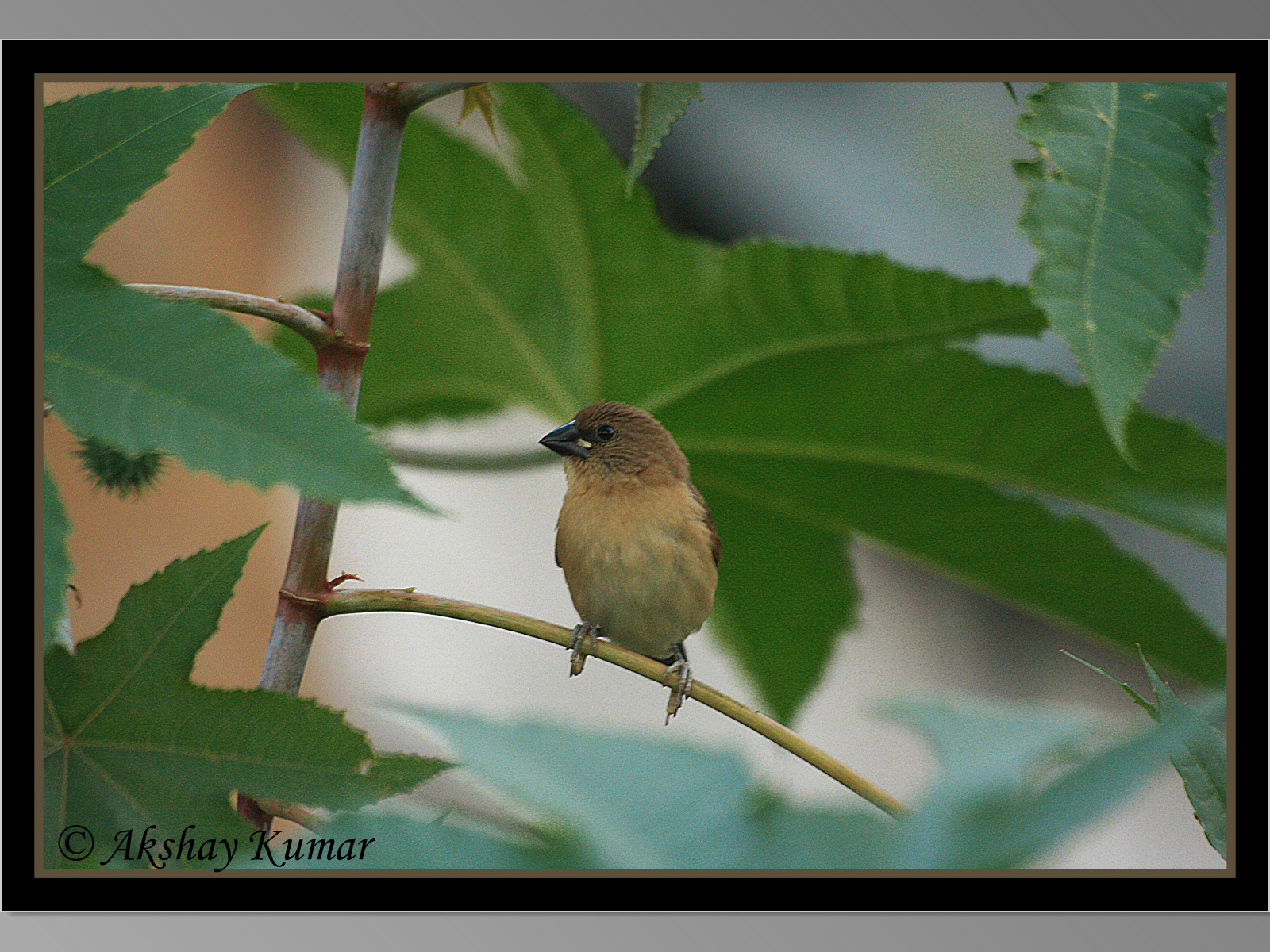
Juvenile Scaly Breasted Munia


Scaly Breasted Munia (Male)


Myna

Spotted Owlet

Pied Bushchat (Female)


Blue Rock Pigeon


Ashy Prinia


Purple Sun Bird


Indian Robin Juvenile (Female)


Indian Robin Juvenile (Female)


Indian Robin (Male)


Scaly breasted munia(Female)


House Sparrow(Female)


House Sparrow (Female)


House Sparrow (Male) feeding on Grass Hopper


Spotted Dove


Spotted Dove


Purple Sun Bird


Purple Rumped Sun Bird( Male)


Blue Rock Thrush


Wag Tail


.

Sunday, 26 June 2011

“The Naturalist and the Trinket Snake”


Scientific Name: Coelognathus helena monticollaris

Trinket Snake
Size:- Adult: 70 cm
        - When Born: 25 cm
        - Maximum: 1.5 m

Non Venomous Snake

Appearance: 
The light brown body with regular black cross bars. It can be identified by the broad dark stripe running along each side of the hind body to the tail tip, two short and dark parallel stripes on the neck, and an oblique stripe running from each eye to the outer edge of the mouth. Sometimes there may be another vertical stripe below the eye.


Nature: It is very famous for its threat display but the snake can be handled with care. They do strike repeatedly when threatened. Active by day and night.

Distribution: Endemic to Western Ghats and some regions around (Karnataka, Tamil Nadu, Kerala, Maharashtra and Goa). In Maharashtra found in ever green forests.

Habitat: During summers, these snakes inhabit the termite mounds and crevices of rocky places while in winter, they prefer the low lying bushes and trees

Feeds on: Just like the famous rat snake of America, the trinket is prodigious rodent eating machine. It feeds on rats, lizards and small birds

Reproduction: The female snake lies around 6 - 8 long slender eggs. The young ones resemble the parents. Once a trinket had laid 8 eggs on February 14 and the young ones hatched out of it on April 11. Another snake had laid eggs in the month of December. They have also been spotted laying eggs during August.

It was a rainy day on the day 20th day of July 2010 when I rescued a trinket snake .As it was raining I did not release her later when examined I realized it was pregnant and I basically wanted keep her with me . 

Couple of days I fed her with mouse. The day cam e on 2nd of July 2010 she started laying eggs, It was night 11.00 pm when she laid her first egg I was fortunate enough to record her laying egg. It was around 2am in the morning when she laid her 8th egg and that was the last egg.


Trinket Snake is a non-venomous constrictor species of colubrid snake

After 2 days I released her back in the wild, I decide to incubate these eggs .after 70 days of constant incubation at 27degree Celsius and maintaining 75%humidity, I was successful to hatch all the eggs. Few days later when they all shed their skin I released them back in wild


Laying eggs


clutch of eggs


Hatching
.

The Indian giant squirrel (Ratufa indica)


Indian giant squirrel

The Indian giant squirrel, or Malabar giant squirrel, (Ratufa indica) is a large tree squirrel species genus Ratufa native to India. It is a large-bodied diurnal, arboreal, and herbivorous squirrel found in South Asia.


Description 

The Ratufa indica has a conspicuous two-toned (and sometimes three-toned) color scheme. The colors involved can be creamy-beige, buff,tan, rust, brown, or even a dark seal brown. The underparts and the front legs are usually cream colored, the head can be brown or beige, however there is a distinctive white spot between the ears. Adult head and body length varies between 14 inches (36 cm) and the tail length is approximately 2 ft (0.61 m). Adult weight - 2 kg (4.41 lb).

Behavior

The Indian giant squirrel is an upper-canopy dwelling species, which rarely leaves the trees, and requires "tall profusely branched trees for the construction of nests." It travels from tree to tree with jumps of up to 6 m (20 ft). When in danger, the Ratufa indica often freezes or flattens itself against the tree trunk, instead of fleeing.[4] Its main predators are the birds of prey and the leopard.[4] The Giant Squirrel is mostly active in the early hours of the morning and in the evening, resting in the midday. It is a shy, wary animal and not easy to discover.


The species is endemic to deciduous, mixed deciduous, and moist evergreen forests of peninsular India,
It occupies isolated ranges that are widely separated from each other, thus producing conditions favorable for speciation. The squirrels found within each of these isolated ranges share distinctive color schemes, making it easy to identify which region a particular squirrel is from, as well as leading to the controversy as to whether these different color schemed subspecies ought to be considered as unique species


Neo Naturalist: POEM

OUR ROOTS ARE DEEP IN THE WOODS!!!!!!
AMONG THE MOSSES ,CLOSE TO THE SPRINGS!!!!!!!!!!!!
OUR SPIRITS SOAR HIGH IN THE SKY!!!!!!!!!!
AMONG THE BIRDS AND BUTTERFLIES!!!!!!!!!!!!!!


Bronze back sanke (Dendralaphis tristis) feeding on The Malabar Flying Frog (Rhacophorus malabaricus)